
Part 2 of 3
Over the next two months, Australians will be asked by postal vote whether they believe federal law should be changed so that same-sex couples can marry.
Like most Australians, I’m concerned that any public debate around this issue is conducted with respect, given that this isn’t merely an “issue”. We’re discussing real peoples’ lives and loves.
My social pipes are already choked with views for and against, but I’m heartened: what I’ve seen so far has been overwhelmingly civil with little evidence of the homophobic Australia I’ve heard exists. Maybe I just have a lot of polite friends.
“This isn’t merely an “issue”. We’re discussing real peoples’ lives and loves.”
As a Christian, I’ve given a lot of thought to this subject. Jesus told us to love God with all our minds, and I assume he says what he means and means what he says. As such, I refuse to vote either “yes” or “no” without considering both sides. And there are compelling arguments either way you look.
Here I have summarised what I see as the three strongest reasons both for and against followers of Jesus voting to change the definition of marriage. You’ll have to keep reading to the end to find out where I land. (Scroll to the bottom now if you’re closed-minded and can only think in black and white).
For #1 | It’s not the church’s place to tell society what to do
I agree. The church once had a privileged position in the West, and while I’m convinced this enabled Jesus’ teachings to impact the world for unspeakable good (check out my series on How Jesus Shaped the West), sadly that status also seduced Christians into grave abuses of power.
Doubtless, those abuses are a big reason for the church’s waning influence on culture. That influence has been a huge loss, and it’s enough to destroy anyone’s faith completely—but only if we’ve confused Christendom with the Kingdom. Christendom has fallen, but God’s Kingdom has never ceased to be in our midst.
“The early church turned the world upside down.”
When I look back in history, the Christians I find most inspiring didn’t occupy halls of power; they spoke with a marginal but powerfully prophetic voice. In short, the Christians who impress me most looked most like Jesus.
Christianity has once again been driven to the margins of society. So it’s time to stop modelling our conduct on the Holy Roman Empire and instead, take our cues from the early church.
“Christendom has fallen, but God’s Kingdom has never ceased to be in our midst.”
For those first 300 years, the church didn’t speak with an air of entitlement. They didn’t legislate or pontificate the moral choices of their secular counterparts. But they did turn the world upside down. And they did it from their knees.
For #2 | Many same-sex relationships outshine straight marriages
The other day I saw a cartoon depicting three weddings. The first was an overnight Las Vegas fling; the second was a couple who had divorced and remarried on repeat; and the third was a loving same-sex couple. The caption read, “Guess which kind of marriage religious people are against?”
It was convicting. In many ways, the church has lost its moral authority, not only by dropping our standards on what marriage should look like, but by making people who sin differently to us feel like they’re in some ugly category all on their own. It’s hypocrisy at its worst.
“In many ways, the church has lost its moral authority.”
Happily, those cartooned examples of heterosexual marriage are the exception rather than the rule, but the illustrator has a really good point. If so much already passes for marriage that shouldn’t, isn’t it unfair to stand in the way of marriage for same-sex couples who set a far better example of love and commitment?
For #3 | Jesus showed the greatest love to the most marginalised
Jesus was a divisive figure. His claim to be God offended everyone. But in particular, he was disliked by progressives for his stuffy moral values, and by conservatives for keeping company with sex workers, white collar criminals, and blue collar dropouts.
Which is a sobering reminder to me as a follower of Jesus that if everyone who thinks I’m a jerk is further left than I am, then I’m probably so far right that I’m wrong.
“Jesus was known as a friend of the marginalised.”
If my convictions about sex are christian but my behaviour isn’t, then I’ve sawed off the branch I’m sitting on. And I must take responsibility when people quote Gandhi, saying, “I like your Christ but I do not like your Christians.”
On the contrary, in my conduct I should look something like Jesus. Religious people were often upset with him, but he was known as a friend of the marginalised. He opposed the proud, but to the humble he showed grace and unexpected love.
“If everyone who thinks I’m a jerk is further left than I am, then I’m probably so far right that I’m wrong.”
Which means that in 2017, I’m more like Jesus if I’m misunderstood as endorsing same-sex marriage than if I’m misunderstood as hating LGBT Australians. I hope I’m not misunderstood at all—but if I err in this way, may I err on the side of love.
Every human being is made in the image of God and has inestimable worth: any convictions I have about sex must come second to that.
So am I voting yes? Well there are a few things I haven’t mentioned yet.
Against #1 | Social moods are an unstable foundation for legal change
Every definition of marriage discriminates. I’m confused by the term “marriage equality” because even if Australia passes it, certain people will still be excluded—namely children and those already married.
I’m not trying to incite fear; I’m not suggesting same-sex marriage will lead to pederastic or polyamorous marriage; I’m not drawing moral equivalence between any of these camps; I’m not assuming any overlap in their agendas.
I’m simply pointing out that zeitgeist is a shaky reason to tamper with a very ancient institution. Those who would like children to marry, or marriage to include three or more members, are today rightly considered odd—even dangerous. But they also make their case in terms of human rights, discrimination, and love.
Zeitgeist, n. the defining spirit or mood of a particular period of history.
I’m not fearful that such arrangements are “coming next”. But in seeking to be like Jesus, I care about my civilisation, and I’m concerned about us breaking our moral compass.
If feelings of love and attraction are the overriding rationale for same-sex marriage, then at best, in the future we will be guilty of unfair discrimination towards other “marriage” configurations where those same feelings are present. At worst, we will have convinced ourselves that this, too, is progress.
It seems so unlikely. But as we’ve seen with the current debate, social moods change quickly, even on a global scale.
Against #2 | The rights of adults shouldn’t trump those of children
Many who marry don’t want to have children. Some who want to have children can’t. Medical advances and adoption provide choices—including for same-sex couples. But none of these scenarios annul one simple observation.
The human race will only progress towards its unfolding history through the bonding of male and female. Marriage has existed through time and culture to honour and protect this profoundly unique reality.
“The human race will only progress towards its unfolding history through the bonding of male and female.”
Same-sex couples now raise families—and many do a better job than married heterosexuals. But to call such a union marriage is for me and many others a definitional oxymoron (kind of like a square circle or a married bachelor), for the simple fact that it lacks the most basic attribute (and therefore potential) of marriage.
To others, this might all sound like semantics. But if marriage is this destiny-shaping institution that same-sex couples want access to, and same-sex marriage enters the fray, there is another considerable problem.
Every child conceived in such a family will be deprived in advance of one of their biological parents. Their natural-born right (recognised even by the U.N.) to be brought up by their mum and dad will have been taken away before they ever got a say in the matter.
“It may be no one’s intention to turn kids into commodities, but the result is the same.”
Irresponsible dads can inflict the same wound, as can sexual abuse, or the death of a parent. But we universally acknowledge these as unwanted scenarios. To enshrine same-sex marriage in law is to bless this absence and call it desirable—in our society’s bedrock institution, no less.
It may be no one’s intention to turn kids into commodities, but the result is the same—all because the rights of adults have been put before the rights of children. To me, that doesn’t seem much like Jesus.
(And ironically, while our society fights for equal representation of the sexes in every sphere of life, same-sex marriages will lack that too).
Against #3 | Human histories and cultures aren’t so easily dismissed
You might have noticed that I’m yet to quote Scripture in discussing the against case. That’s because I don’t assume everyone reading this views the Bible as a legitimate authority.
Jesus certainly did quote Genesis to teach that marriage is between a man and a woman—and considering he was a Jew in first century Israel, if he was radical in approving of same-sex relationships, we’d need radical evidence for it. And that does seem to be missing from the gospel accounts.
I don’t expect much praise for it, but even in my convictions on human sexuality, I hope to be like Jesus. (I’ve written about the views that Jesus and other biblical authors held on sexuality here).
“Jesus taught that marriage is between a man and a woman.”
But whether it’s Judaism or Christianity; Islam, Buddhism or Hinduism; cults or schisms or other isms, almost every human culture through almost all of human history has understood marriage to be the union of sexually complementary spouses.
This deep history is why I’m shocked that classical marriage is now being framed as controversial, or even intolerant. (I have a few thoughts on this unusual new morality). Those who believe in it are only agreeing with almost every one of the tens of billions of people who have ever lived.
Traditional doesn’t always equal true. But I pay attention to what cultures have done en masse from the dawn of civilisation to the present. And as a Christian, Jesus’ views on sexuality must be my views on sexuality.
How I’ll Vote on Same-Sex Marriage
When I look at the relationships Jesus had, what strikes me most of all is his ability, in the words of John Dickson, to flex both the muscle of ethical conviction and the muscle of compassion. To profoundly disagree with people, yet befriend and love them all the same.
As I weigh up my options, I’m struck that a vote for same-sex marriage won’t allow me the opportunity to flex both of those muscles. To do this—to be like Jesus—I have only one option: I must vote for the ideal of marriage that Jesus upheld.
When I cast my vote, like in any election, I’ll vote not as a representative of the institutional church, but as me. Sure, I’m a Christian, but my conscience and opinion counts like any other Australian. And I’ll also vote with humility, aware of the past failures of many who said they represented Christ.
“I’ll vote not as a representative of the institutional church, but as me.”
If that doesn’t sound progressive enough, consider C. S. Lewis: “If you are on the wrong road, progress means doing an about-turn and walking back to the right road; and in that case the man who turns back soonest is the most progressive man.”
~
If the opinion polls are right, by November same-sex marriage will be law in Australia. The media pack, led by the ABC, seems to have all but ensured that. (I tend to think the media is at its best when it’s trying to inform, rather than form public opinion—especially when it’s taxpayer funded).
In the midst of this, some of us need reminding that if same-sex marriage does pass as law, the sun will actually rise the next day and life will go on as usual.
If I’m honest, in the years to come, I’m concerned about what that might look like for my freedoms, particularly as a pastor. But what concerns me more in the present is being the kind of voice and hands and feet that society will miss—and wish they hadn’t suppressed—if it ever comes to that.
“If I err, may I err on the side of love.”
There’s no point in winning the battle but losing the war. I don’t want to go down fighting. I want to go down loving. In that too, I want to be like Jesus.
Read the rest of the series on Same-Sex Marriage: PART 1 | PART 2 | PART 3
I also help Christian leaders get their ideas into print. If you have a book in you, see Ghost Right; if your manuscript is already written, Set Apart takes it to a finished, self-published book.
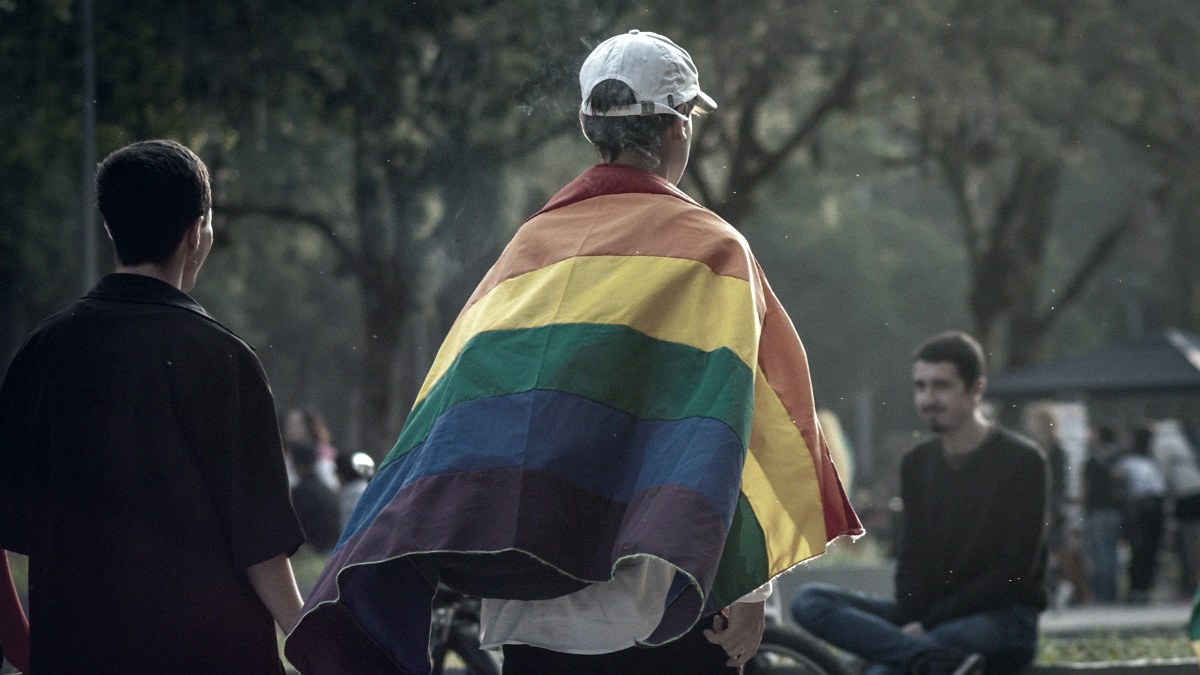
Image by Sandy Millar on Unsplash.




Leave a Reply